
Ignis Agent Meets OpenClaw: Revolutionizing AI-Driven Game Development and Autonomous Agent Worlds
Key Takeaways
- OpenClaw serves as the leading open-source framework for building autonomous AI agents that control real systems and execute tasks independently, fueling viral experiments in agent-based 'games' where AIs interact in virtual environments.
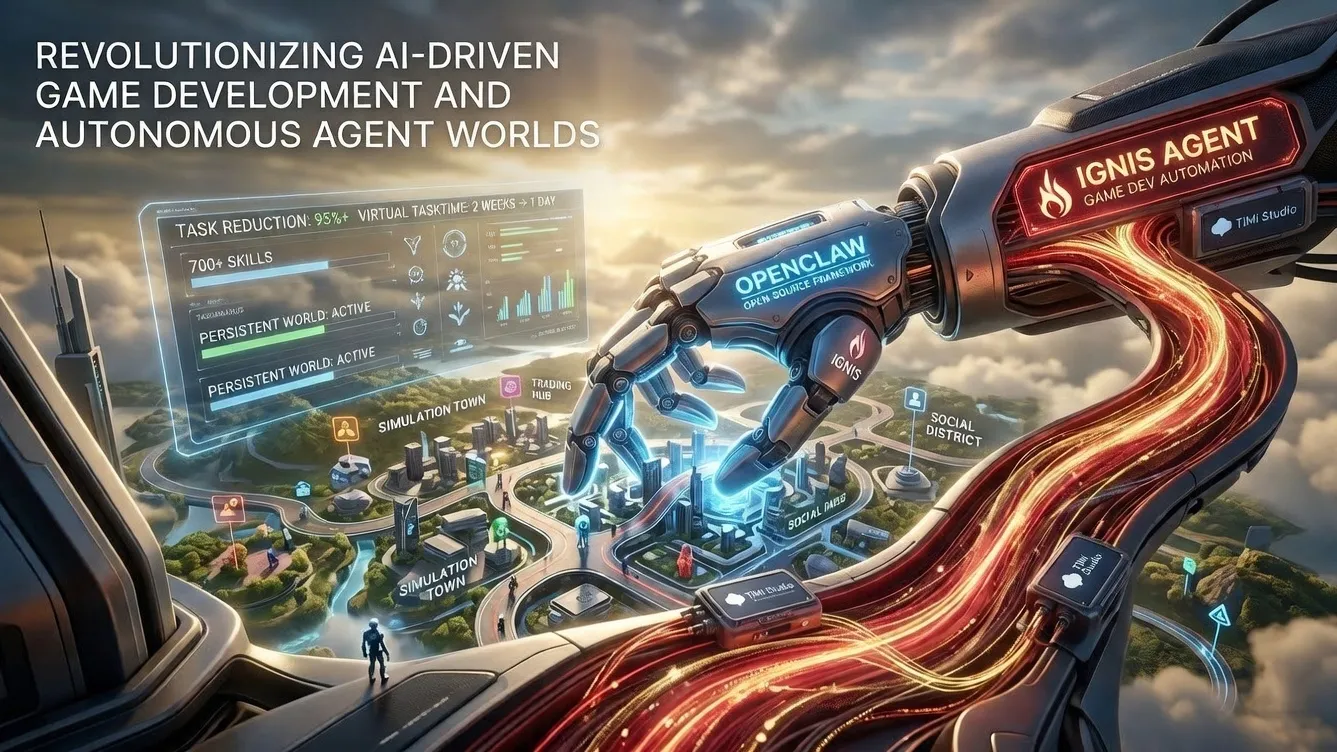
- Ignis Agent, developed by Tencent's TiMi Studio, specializes in game industry automation—streamlining planning, UI implementation, and engineering with 95%+ workflow reduction in complex projects.
- Combining paradigms from both enables hybrid approaches: using OpenClaw-style agents for dynamic in-game behaviors or testing, while Ignis handles production-scale creation.
- Benchmarks show Ignis cuts 2-3 week tasks to 1 day; OpenClaw communities report agents building apps overnight or simulating persistent worlds.
- Security remains critical: local execution in OpenClaw reduces cloud risks but demands careful skill vetting; enterprise adaptations (e.g., Nvidia's NemoClaw) prioritize controlled environments.
What Is OpenClaw and Why It Feels Like a Game Changer
OpenClaw transforms large language models into proactive agents capable of think → plan → act → observe loops. Running locally, it accesses desktops, terminals, browsers, emails, calendars, and APIs—executing multi-step tasks without constant supervision.
Core architecture highlights:
- Persistent state and memory enable long-running operations.
- Skills ecosystem (700+ community-built) extends capabilities, from web scraping to code deployment.
- Chat integration (WhatsApp, Telegram, Discord) makes interaction seamless, like texting an employee.
Community feedback suggests OpenClaw's appeal lies in autonomy: users report agents managing portfolios, booking classes, or even trading crypto 24/7. In experimental setups, teams deploy OpenClaw agents into virtual towns (e.g., AIvilization), where agents observe events, form 'friendships,' post updates, and evolve behaviors—creating emergent simulation 'games' with minimal player input.
Why this gamifies AI: Agents interact independently, leading to unpredictable, RPG-like progression. Token costs concentrate on world simulation rather than player queries, making it feasible on personal hardware.
Ignis Agent: Tencent's Powerhouse for Game Production Automation
In contrast to general-purpose agents, Ignis Agent targets game development bottlenecks. Deployed in large-scale projects, it participates in:
- Game design document generation
- UI system implementation
- Complex engineering decisions requiring high accuracy
Analysis shows Ignis achieves 95-98% automation in targeted pipelines, reducing human effort by over 95% and compressing timelines dramatically. Unlike chat-based tools, it emphasizes decision correctness in engineering contexts—vital for stability in massive codebases.
Practical advantages:
- Handles repetitive, error-prone tasks in production.
- Integrates with vertical workflows (e.g., lighting/audio agents like MagicDawn).
- Enables developers to focus on creative, high-level strategy.
How OpenClaw and Ignis Paradigms Intersect in AI Game Development
Edge case synergy emerges when OpenClaw's autonomy meets Ignis-style precision:
- Use OpenClaw agents to prototype in-game AI behaviors or simulate player interactions.
- Leverage Ignis for automating asset creation, balancing, or code generation within those simulations.
- In agent swarms: Deploy multiple OpenClaw instances in virtual worlds for testing game economies, NPC societies, or emergent narratives—mirroring trends in realtime AI video games and agent Earth simulations.
Advanced tips:
- Local-first setup — Run OpenClaw with Ollama or LM Studio on consumer GPUs for privacy and cost control.
- Project scoping (inspired by forks like OpenIgnis) — Isolate agent memory per 'game' or feature branch to prevent context pollution.
- Skill vetting — Use VirusTotal partnerships and sandboxing to mitigate risks in community extensions.
Common pitfalls:
- Overexposing instances publicly (thousands found vulnerable).
- Token overconsumption in unoptimized loops.
- Ignoring hallucination risks in high-stakes decisions—always implement human review gates.
Security and Enterprise Evolution
Benchmarks indicate local execution enhances privacy, but agent privileges demand safeguards. Nvidia's reported NemoClaw (enterprise OpenClaw analog) and integrations (e.g., DGX Spark) signal maturation toward secure, scalable deployments.
Conclusion
The fusion of OpenClaw's autonomous freedom with Ignis Agent's production-grade precision signals a shift toward truly agentic AI in gaming and beyond. Developers gain tools to automate creation while experimenting with living virtual worlds.
Call to action: Explore OpenClaw at openclaw.ai, experiment with local deployments, or integrate agentic workflows into your game pipeline. The era of AI that doesn't just assist—but builds, simulates, and evolves—is here. Start building your agent today.