
AI Is Devouring Industries with Crushing Force – The Takeover Has Begun
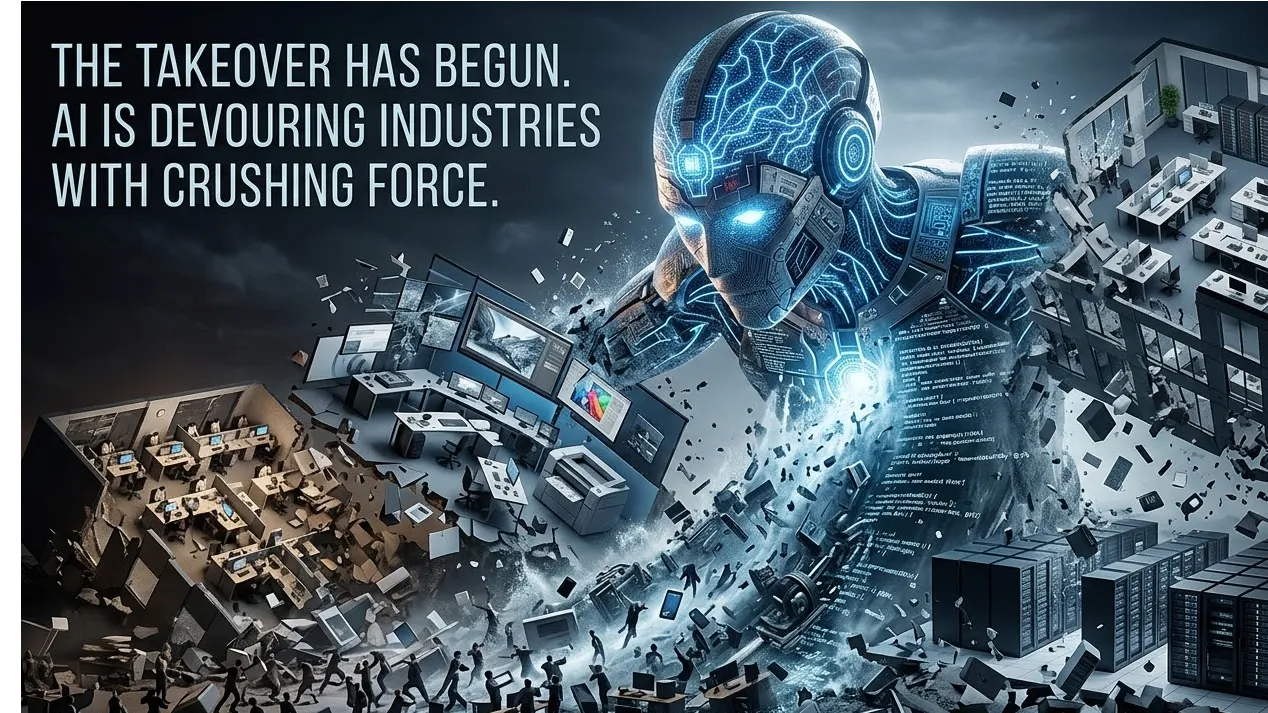
AI is advancing at a pace that leaves no room for complacency. It’s not gently assisting industries—it’s devouring them with the force of a tidal wave wherever tasks can be automated, analyzed, or generated at scale. The evidence from 2025 and early 2026 is undeniable: AI isn’t coming for jobs. It’s already here, reshaping entire sectors with ruthless efficiency.
The Unstoppable Scale of AI Disruption
Data reveals the magnitude. AI contributed to nearly 55,000 U.S. layoffs in 2025 per Challenger, Gray & Christmas analyses. Goldman Sachs projects up to 300 million full-time jobs globally exposed in its workforce report. Employment in graphic design, office administration, and call centers has fallen below historical trends. In tech-exposed occupations, unemployment for workers aged 20-30 has risen sharply.
Productivity surges tell the other side: companies adopting AI see 35-45% gains in software development and faster market entry. This efficiency comes at a human cost—fewer roles needed.
Industries Already Being Consumed
Software Development
AI tools are transforming coding. Requirements-to-prototype cycles shrink by 30%, with productivity up 35-45%. Tech sectors like computer systems design and software publishing report slowed hiring and outright cuts, as AI handles routine development.
Creative and Content Production
Tools for image generation and writing are displacing entry-level roles. Graphic design demand lags, while copy editors and market analysts face 60%+ exposure. Agencies now produce campaigns with minimal human input.
Customer Service and Administration
AI agents slash support volumes by 50% in many brands. Customer service reps, data entry keyers, and administrative assistants—occupations with 67-70% AI exposure—are seeing demand plummet. Call centers, once booming, stagnate.
Finance, Legal, and Beyond
Back-office finance anticipates 200,000 Wall Street cuts. Legal contract review and manufacturing assembly lines follow, with projections of 2 million manufacturing jobs automated by 2026.
Counterarguments Fall Short
Skeptics claim AI creates net jobs and boosts growth. PwC’s 2025 AI Jobs Barometer shows AI-exposed industries growing revenue per employee three times faster. Yet this productivity favors fewer, higher-skilled workers. Entry-level white-collar positions—programmers, analysts—are vanishing fastest.
Human elements like empathy remain, they say. True for healthcare or strategy. But in devourable domains—routine, data-driven work—AI achieves "good enough" at fractions of the cost. Anticipatory layoffs at major firms confirm executives see the writing on the wall.
Actionable Steps for Survival
Teams must act decisively:
- Orchestrate AI, Don’t Compete With It: Developers shift to high-level architecture and validation.
- Build Hybrid Workflows: Use AI for volume tasks; reserve humans for creativity and oversight.
- Upskill Relentlessly: Focus on prompt mastery, AI ethics, and domain integration.
- Redesign Roles: Prioritize critical thinking over repetition.
Laggards risk irrelevance.
The Bottom Line
AI is devouring every industry it can reach with crushing, unstoppable force. The 2025-2026 data on layoffs, productivity, and slowed sectors prove it: resistance leads to obsolescence. Teams and developers who integrate AI aggressively today will thrive. Those who hesitate will be consumed. The time to adapt is now—embrace the change or become its next victim.