
Baidu: The AI Huangpu Military Academy That Produced Andrew Ng, MiniMax Founder Yan Junjie, and Claude’s Dario Amodei
Key Takeaways
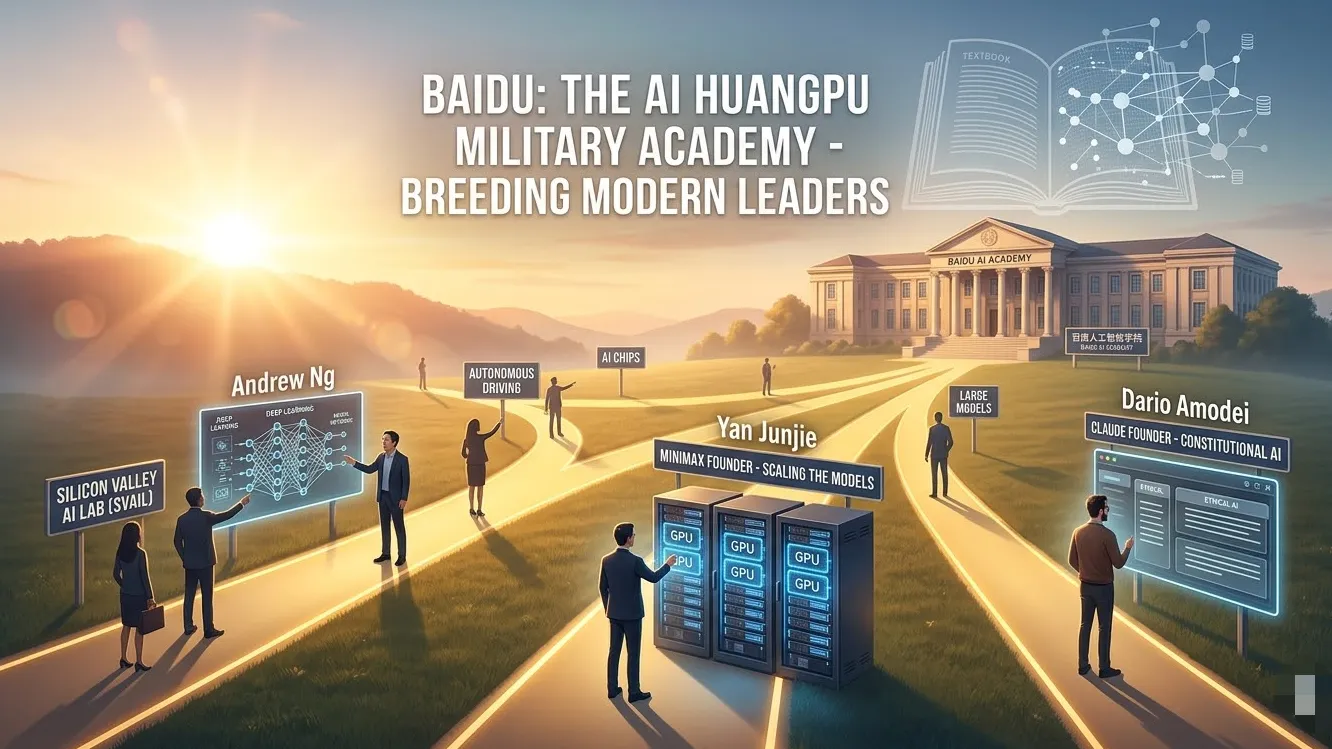
- Talent Factory Scale: Analysis shows over 133 AI startups trace their roots to Baidu alumni, spanning autonomous driving, chips, large models, and enterprise AI.
- Andrew Ng Era (2014–2017): As Chief Scientist, Ng established the Silicon Valley AI Lab (SVAIL), attracting global talent with China’s largest GPU clusters and massive search data.
- MiniMax Founder Yan Junjie: The 2014 Baidu intern (and scholarship winner) used one-third of the lab’s GPUs for experiments; his company now exceeds Baidu’s market cap after just four years.
- Claude Founder Dario Amodei: Worked at Baidu’s SVAIL 2014–2015 on Deep Speech 2; later co-founded Anthropic, whose Constitutional AI powers the Claude series.
- Why It Works: Early investment in deep learning infrastructure + real-world data created unmatched training ground, though talent retention remains a persistent challenge.
Baidu’s Silicon Valley AI Lab: The Cradle of Modern AI Leaders
Benchmarks indicate that 2014 marked the turning point when Andrew Ng joined Baidu as Chief Scientist. He quickly launched the Silicon Valley AI Lab, recruiting top researchers worldwide. The lab featured China’s largest GPU cluster at the time and access to billions of search queries—resources few Western labs could match.
This environment accelerated breakthroughs in speech recognition, computer vision, and foundational models. Community feedback suggests the combination of academic freedom and industrial-scale data turned Baidu into a true talent incubator, far beyond typical corporate R&D.
Andrew Ng: The Architect Who Built the Academy
Ng’s leadership transformed Baidu’s AI efforts from experimental to world-class. He recruited researchers like Dario Amodei and fostered projects such as Deep Speech 2, which set new benchmarks for end-to-end speech recognition using deep neural networks. Ng’s vision emphasized practical deployment, teaching talents how to move from research papers to production systems at scale.
His departure in 2017 did not end the legacy; instead, the lab’s alumni carried the methodology forward into startups and global giants.
MiniMax Founder Yan Junjie: From Baidu Intern to Market Cap Challenger
In 2014, 25-year-old Yan Junjie interned at Baidu’s depth learning institute while pursuing his PhD. He received the Baidu Scholarship and leveraged roughly one-third of the lab’s GPU resources for large-scale experiments. This hands-on access to real industrial infrastructure gave him early insight into the power of massive computation and data.
After stints at SenseTime, Yan founded MiniMax in 2021. The company pioneered commercial Mixture-of-Experts (MoE) models in China, achieving trillion-parameter scale with abab 6.5 and open-sourcing MiniMax-01 series. As of March 2026, MiniMax’s market cap surpassed Baidu’s—proof that the internship lessons scaled globally.
Claude Founder Dario Amodei: Baidu to Anthropic’s Constitutional AI
Dario Amodei joined Baidu’s SVAIL in 2014 at Andrew Ng’s invitation, contributing to early speech and deep learning projects including Deep Speech 2. After leaving for Google and then OpenAI (where he helped develop GPT-2 and GPT-3), he co-founded Anthropic in 2021 with a focus on AI safety.
Anthropic’s flagship Claude models use Constitutional AI—a framework where models self-critique against written principles to reduce hallucinations and bias. This approach directly echoes the rigorous, data-driven methodology Amodei absorbed during his Baidu years. Today, Claude 3.5 Sonnet leads in reasoning and coding benchmarks, serving enterprise clients worldwide.
Why Baidu Outperformed Other Tech Giants as Talent Incubator
Comparisons with Google, Microsoft, or Tencent reveal Baidu’s unique edge: early, aggressive investment in open-source frameworks like PaddlePaddle combined with proprietary data advantages. While many labs focused on theory, Baidu emphasized deployment at scale—exactly the skill set founders need.
Edge cases highlight the model’s limitations: heavy talent outflow (often called “Baidu alumni entrepreneurship wave”) sometimes strained retention. Common pitfalls for ex-Baidu engineers include over-reliance on massive GPU clusters without learning cost-efficient architectures like MoE—lessons Yan Junjie later applied successfully.
Advanced tips circulating in AI communities: replicate Baidu-style projects by combining public datasets with local GPU experiments; prioritize safety and scalability frameworks (as Amodei did); and build cross-border networks early.
The Broader Impact: 133+ Companies and Global Ripple Effects
IT Orange data shows Baidu alumni founded companies across the entire AI chain: autonomous driving (Pony.ai, WeRide), chips (Horizon Robotics), large models (MiniMax), and more. This ecosystem effect mirrors historical military academies—producing leaders who reshape industries.
Geopolitical nuances add complexity: Amodei’s Anthropic now restricts Claude access for majority Chinese-owned entities, illustrating how Baidu-trained talent can influence global AI policy.
Future Outlook: Will Baidu Retain Its Academy Status?
With new waves of generative AI and agent technology, Baidu continues investing in open platforms. Yet the real legacy lies in its alumni network. As MiniMax surpasses its former employer and Claude leads safety benchmarks, the “Huangpu” effect shows no signs of slowing.
Conclusion
Baidu’s role as AI’s Huangpu Military Academy stems from deliberate infrastructure, visionary leadership under Andrew Ng, and real-world scale that turned interns and researchers into global founders. The stories of Yan Junjie and Dario Amodei prove that early exposure to industrial AI resources creates compounding advantages.