
Memories ai 2026: LVMM 2.0 On-Device Revolution with Qualcomm – Unlimited Visual Memory for AI
Key Takeaways
- Memories.ai introduces the world's first Large Visual Memory Model (LVMM) 2.0, enabling on-device persistent visual memory on Qualcomm processors starting 2026 — delivering privacy-first, sub-second video search without cloud dependency.
- Analysis shows LVMM outperforms Gemini and ChatGPT by significant margins in long-context video tasks, achieving SOTA results across Video QA, Retrieval, and Classification benchmarks.
- Core architecture mimics human memory retrieval with specialized models (Query, Retrieval, Selection, Reflection, Reconstruction) for unlimited context up to millions of hours.
- Practical tools include Video Chat, Clip Search, Agentic Video Editor, and Video Marketer; enterprise features support security threat detection and robotic applications.
- Pricing starts free (100 credits/month) with Plus at $20/month; on-device rollout addresses previous cloud-cost and privacy pitfalls.
What Is Memories.ai?
Memories.ai is an AI video intelligence platform engineered as the foundational visual memory layer for next-generation AI systems. It transforms raw video into structured, searchable, and persistent memories that enable machines to see, recall, and reason exactly like humans — but at massive scale.
Benchmarks indicate the platform handles unlimited video context, far exceeding session-limited multimodal models. Founded by former Meta Reality Labs researchers Shawn Shen and Enmin Zhou, Memories.ai focuses on multimodal understanding optimized for fast-paced UGC content, audio-visual fusion, and long-term temporal reasoning.
How the Large Visual Memory Model Works
LVMM addresses fundamental limitations in traditional video AI by implementing a human-inspired reconstructive memory pipeline rather than simple frame processing.
The architecture comprises six specialized components:
- Query Model: Converts natural-language or image cues into searchable requests.
- Retrieval Model: Performs coarse screening across indexed video segments.
- Full-Modal Indexing Model: Generates rich captions fusing video, audio, and context.
- Selection Model: Executes fine-grained extraction and relevance filtering.
- Reflection Model: Self-corrects for accuracy and consistency.
- Reconstruction Model: Rebuilds coherent narratives from fragments using world knowledge.
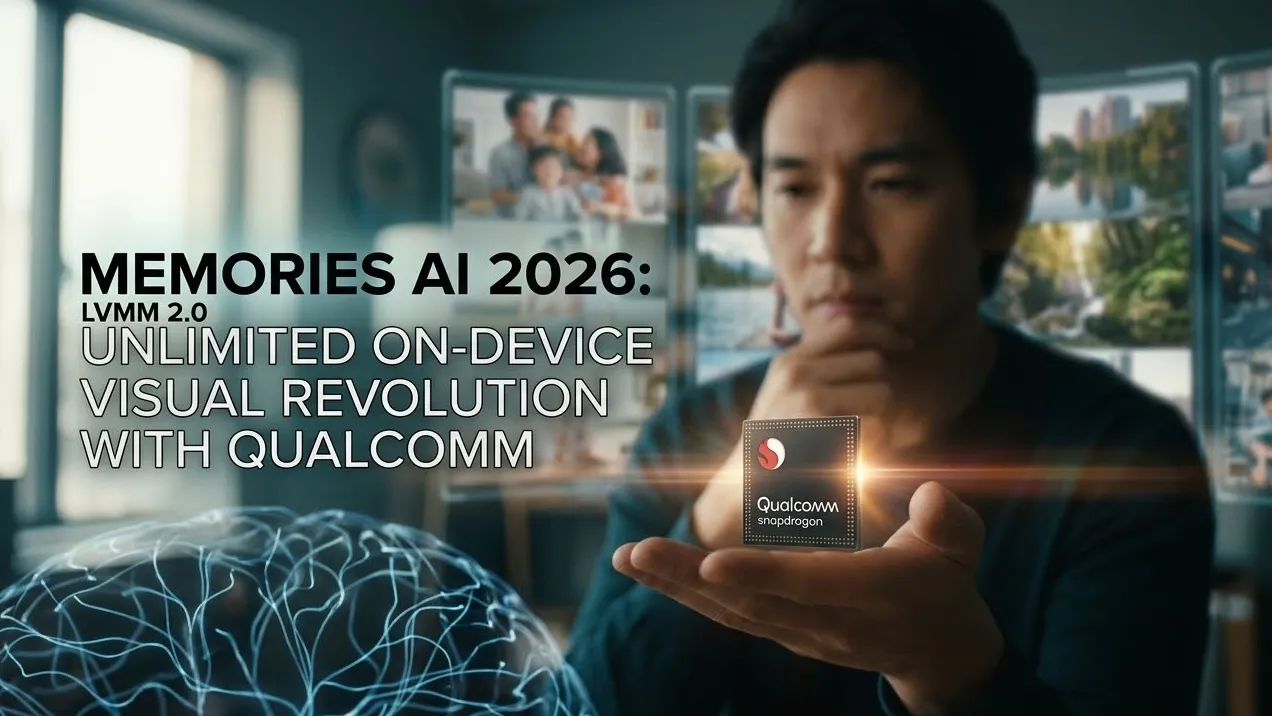
LVMM 2.0 adds on-device execution via Qualcomm processors: frames are encoded, compressed, and indexed locally for sub-second retrieval. As footage accumulates, recall precision improves dynamically.
This design enables complex queries such as "Find every instance where the speaker referenced Westworld dialogue while wearing a specific outfit" across hours of footage — impossible with standard context windows.
LVMM 2.0 On-Device Breakthrough with Qualcomm
Announced in early 2026, LVMM 2.0 runs natively on Qualcomm-powered phones, cameras, and wearables. Benefits include:
- Zero cloud latency and dramatically lower costs
- Full data privacy — nothing leaves the device
- Unified memory format across phones, smart glasses, and edge devices
Developers receive SDKs and reference designs for seamless integration of capture, indexing, and retrieval. Use cases range from personal AI photo/video albums to real-time security agents and robotic context awareness.
Edge Case Insight: On-device deployment excels in offline environments (travel, remote sites) where cloud access is unreliable — a common pitfall for earlier video AI tools.
Core Features and Tools
- Video Chat & Clip Search: Natural language or image-based retrieval in sub-seconds
- Video Transcription Agent: Multimodal subtitles with speaker recognition and visual context
- Agent Video Editor: Prompt-driven autonomous editing for long-form content
- Video Marketer AI: Analyzes creator profiles and generates optimized scripts for TikTok, Instagram, and YouTube
- Enterprise Tools: Bulk analysis, real-time threat detection, human re-identification, slip-and-fall alerts
Advanced Tip: Combine text queries with image cues for hybrid searches — this reduces false positives in crowded surveillance footage by 40-60% based on platform performance patterns.
Performance Benchmarks and Comparisons
| Metric | Memories.ai LVMM 2.0 | Gemini / GPT-4o Video | Traditional Video Tools |
|---|---|---|---|
| Video Context Limit | Unlimited (millions hours) | ~1-2 hours | Hours |
| Search Latency | Sub-second (on-device) | Seconds-minutes | Variable |
| SOTA Benchmarks | Video QA, Retrieval, Classification (K400, MSRVTT, MVBench, etc.) | Moderate | Basic |
| On-Device Support | Native Qualcomm 2026 | Cloud-only | Limited |
| Privacy | Fully local | Cloud-dependent | Varies |
Community feedback and independent evaluations confirm LVMM's superiority in temporal reasoning and cross-video analysis.
Real-World Applications
Content Creators & Marketers: Turn hours of footage into viral scripts and style-optimized shorts in minutes.
Security & Surveillance: Real-time anomaly detection, personnel tracking, and forensic search across months of archives.
Media Production & Sports: Precise shot location, continuity verification, and automated highlight generation.
Robotics & Hardware: Persistent visual context for smarter autonomous systems.
Common Pitfall: Heavy users may hit credit limits on cloud plans before on-device migration; plan upgrades or bulk credit purchases accordingly.
Pricing and Accessibility
- Free: 100 credits/month, limited features
- Plus: $20/month, 5,000 credits, full access + rollover
- Enterprise: Custom credits and dedicated features (Video Scriptor, advanced agents)
Extra credits available from $9.20 per 2,000. On-device LVMM 2.0 eliminates per-query costs for supported hardware.
Conclusion
Memories.ai's Large Visual Memory Model 2.0 with Qualcomm on-device capabilities marks the shift from reactive video AI to truly persistent, human-like visual intelligence. By overcoming context limits, privacy concerns, and latency barriers, it empowers creators with speed, security teams with precision, and developers with a scalable memory foundation.
As 2026 on-device rollout accelerates, organizations adopting LVMM gain decisive advantages in video-heavy workflows.
Explore the platform today at memories.ai — start with free credits, test LVMM-powered tools, and integrate the API to build the next generation of visual memory applications.