
MuleRun vs OpenClaw: Cloud AI Agents vs Open-Source Self-Hosted Assistants Compared
Quick Comparison
| Aspect | MuleRun | OpenClaw |
|---|---|---|
| Type | Cloud-native managed VM per user | Open-source self-hosted |
| Uptime | 24/7 guaranteed on dedicated cloud | Depends on your hardware/VPS |
| Pricing | Free tier + $16/mo (Plus) or $160/mo (Pro) with monthly credits | Free software + LLM API costs (~$20–100/mo) + optional VPS ($5–20/mo) |
| Setup | Browser-based, no install | One-liner script + integrations |
| Ecosystem | Agent marketplace + collective intelligence | 319k GitHub stars, 61k forks, community plugins |
| Access | Plain English workflows | Chat apps (WhatsApp, Telegram, etc.) |
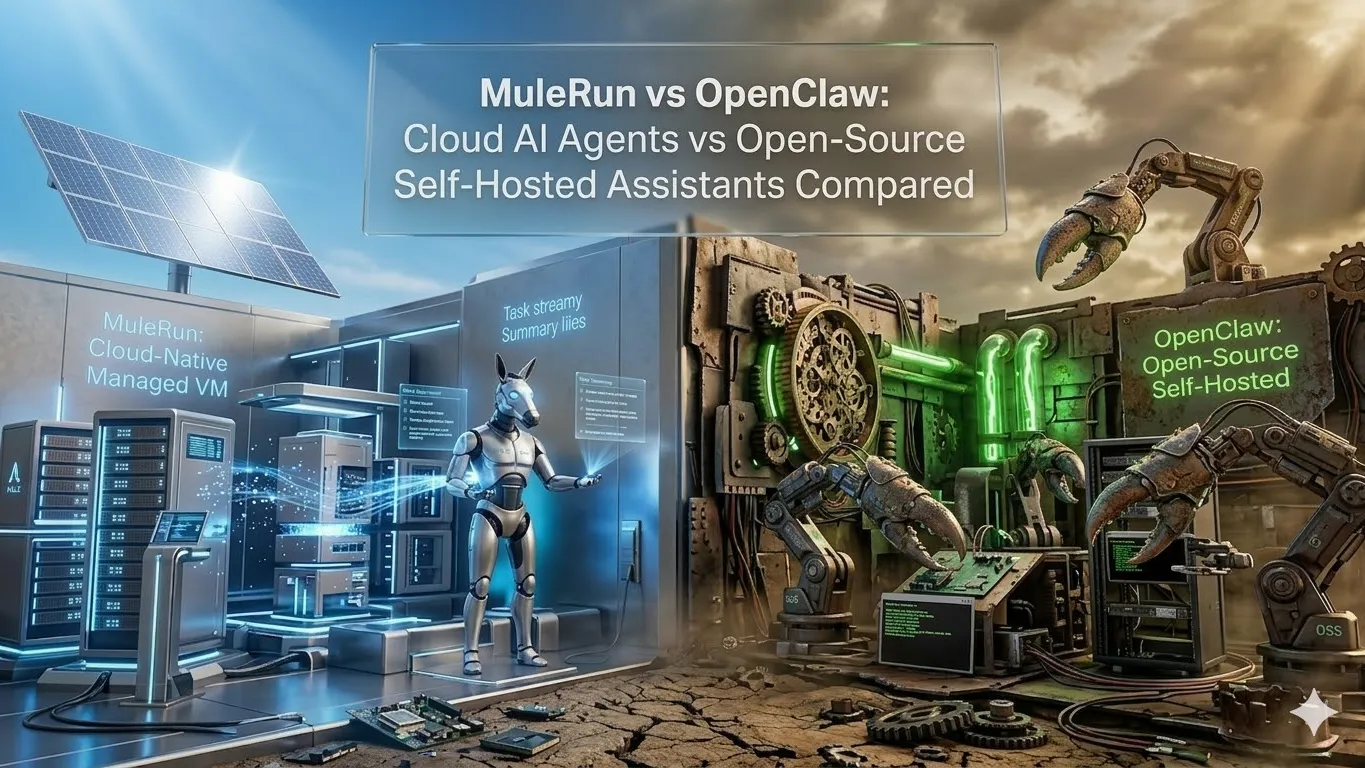
MuleRun provides a dedicated cloud computer that runs agents continuously and learns from collective patterns. OpenClaw gives full local control via open-source code you host yourself.
Performance
MuleRun runs on isolated cloud VMs with proactive features like Heartbeat monitoring for real-time summaries and auto-execution of tasks (e.g., overnight financial reports or e-commerce inventory alerts). It handles multi-step workflows autonomously, scaling compute as needed, and claims fewer errors over time through self-evolution.
OpenClaw executes via your hardware using tool-calling on models like Claude or GPT. It supports cron jobs, browser control, shell commands, and background tasks. Performance scales with your setup: a Raspberry Pi handles basic monitoring, while a Mac Studio or VPS delivers faster complex automations like GitHub PR reviews or full website builds.
Trade-off: MuleRun offers consistent, always-on speed without local resource drain. OpenClaw can feel faster on high-end hardware but stops if your device powers down.
Pricing
MuleRun uses a credit system ($1 = 100 credits) for compute, models, and agent runs:
- Free: 2,000 bonus credits, 10 GB storage, 5 pages deploy, limited parallel tasks.
- Plus ($16/mo): 2,000 credits/month, 100 GB storage, unlimited parallel tasks.
- Pro ($160/mo): 20,000 credits/month, 1 TB storage, early feature access.
Credits cover agent execution; extra can be topped up.
OpenClaw core is free and MIT-licensed. Costs come from:
- LLM API (Claude 3.5 Sonnet or GPT-4o: $20–100+/mo heavy use).
- Optional VPS for 24/7 ($5–20/mo on providers like DigitalOcean).
- Zero software fees.
Trade-off: MuleRun has predictable monthly billing but usage caps on free tier. OpenClaw stays near-zero if you use local models or light API calls but requires upfront setup investment.
Ease of Use
MuleRun lets you describe workflows in plain language via browser chat—no coding, no servers. Agents auto-execute, learn habits, and deliver results to email or Slack. Non-technical users build e-commerce managers or trading bots quickly.
OpenClaw installs with curl -fsSL https://openclaw.ai/install.sh | bash or npm install -g openclaw@latest, then openclaw onboard. It runs in your chat apps and uses an onboarding wizard. Power users extend it with skills, but initial integrations (Gmail, Calendar, GitHub) demand configuration.
Trade-off: MuleRun wins for zero-maintenance beginners. OpenClaw rewards tinkerers who want deep customization but has a steeper initial curve.
Ecosystem
MuleRun features a marketplace for buying, selling, and monetizing agents (Creator Studio handles payments and distribution). Agents share anonymized patterns for collective intelligence—e.g., validated e-commerce strategies improve all instances.
OpenClaw boasts 319k GitHub stars and 61.1k forks (as of March 2026), with 1,231 contributors. The skills platform includes community plugins for Todoist, Spotify, Obsidian, and more. Users build multi-agent systems and share via GitHub.
Trade-off: MuleRun’s marketplace enables monetization and ready-made agents. OpenClaw’s open ecosystem offers unlimited free extensions and full transparency.
Security and Privacy
MuleRun uses physical VM isolation—no access to local passwords or files. Data stays in the cloud with approval checkpoints for sensitive actions.
OpenClaw runs locally with sandboxing options and VirusTotal skill scanning. Full system access is powerful but requires careful permission management (e.g., DM pairing, no admin rights by default).
Trade-off: MuleRun reduces local attack surface for businesses. OpenClaw gives complete data sovereignty but demands user vigilance.
Which Should You Choose?
Choose MuleRun if:
- You need true 24/7 operation without managing servers.
- You’re non-technical and want agents that learn your patterns automatically.
- Business use cases like e-commerce monitoring, quantitative trading, or team workflows matter most.
- You value a marketplace for plug-and-play agents.
Choose OpenClaw if:
- Privacy and full control are non-negotiable.
- You enjoy customizing open-source tools and building community skills.
- You already have hardware (or cheap VPS) and prefer zero recurring software fees.
- Complex personal automations via chat apps (e.g., flight check-ins, calendar + email) fit your lifestyle.
Both deliver proactive AI agents beyond simple chatbots. Test MuleRun’s free tier at mulerun.com/chat and OpenClaw’s install at openclaw.ai. The right choice depends on whether you prioritize managed convenience or open-source flexibility.