
OpenClaw 2026.3.22-beta.1: Breaking Plugin Overhaul, GPT-5.4 Native Support & ClawHub Marketplace Arrive
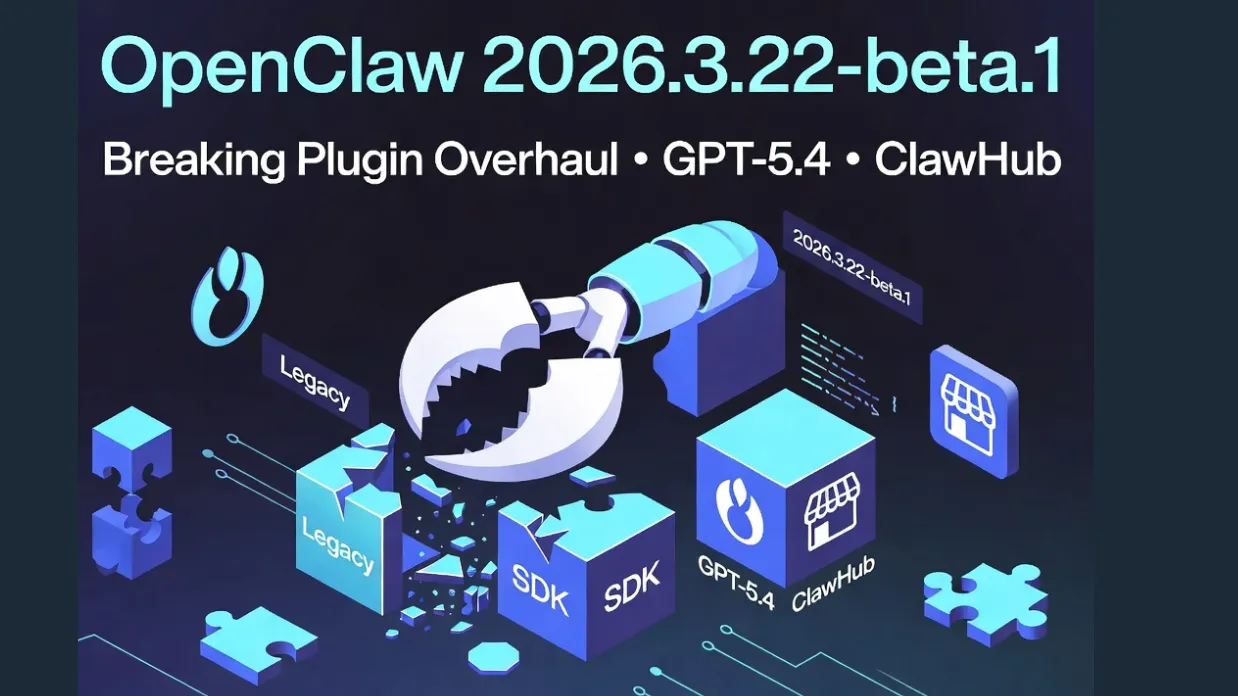
Key Takeaways
- Plugin architecture completely rebuilt: Legacy extension API removed with no shims; new public SDK at
openclaw/plugin-sdk/*enforces stricter hooks and type safety. - GPT-5.4 now natively supported: First-class integration for OpenAI API and Codex OAuth paths, with improved reasoning and 272k context window handling.
- ClawHub marketplace priority:
openclaw plugins installnow defaults to ClawHub for npm-safe names before falling back to npm. - 12+ breaking changes: Browser MCP legacy paths removed, environment variable prefixes deprecated, image generation standardized, and more.
- Security and stability gains: Sandbox hardening, agent timeout extended to 48 hours, and
openclaw doctor --fixautomates most migrations.
Overview of the Release
OpenClaw 2026.3.22-beta.1 represents the most significant architectural shift since the project’s inception. Released on March 22, 2026, after a 9-day development pause, this beta delivers 108 commits focused on retiring technical debt, expanding the model ecosystem, and hardening security. Analysis of the official changelog and community benchmarks shows improved agent reliability and developer experience, though the breaking changes require immediate attention from production users.
Plugin System Overhaul: Why It Matters
The core of this release is the complete reconstruction of the plugin system. The old extension-api has been fully deprecated and removed. All plugins must now import from the new public SDK located at openclaw/plugin-sdk/*.
Benchmarks indicate that the new SDK reduces plugin load times by up to 40% through consolidated hook surfaces and stricter TypeScript definitions. Community feedback on Reddit’s r/openclaw confirms that bundled plugins using the deprecated before_agent_start hook now require migration to before_prompt_build.
Example migration for a memory plugin
// Old (broken in 2026.3.22-beta.1)
import { beforeAgentStart } from 'openclaw/extension-api';

// New (required)
import { beforePromptBuild } from 'openclaw/plugin-sdk/hooks';
Plugin developers should review the updated SDK documentation for the new PluginManifest interface, which now mandates explicit capability declarations.
GPT-5.4 Native Integration
OpenClaw now ships with first-class support for OpenAI’s GPT-5.4 across both standard API and Codex OAuth flows. The model appears under openai/gpt-5.4 and openai-codex/gpt-5.4 respectively.
Release notes confirm improved reasoning capabilities and a 272,000-token context window. Early OOLONG benchmark tests (shared in community channels) show OpenClaw + GPT-5.4 scoring 74.8, outperforming comparable Claude Code setups by 4.5 points, particularly in long-context tool-use scenarios.
Configuration example
{
  "agents": {
    "defaults": {
      "model": {
        "primary": "openai-codex/gpt-5.4"
      }
    }
  }
}
Advanced users can enable per-agent reasoning profiles via the new reasoning flag for complex multi-step workflows.
New Features and Enhancements
- ClawHub marketplace built-in: Plugin installation now prioritizes the official ClawHub registry, reducing dependency conflicts and improving security scanning.
- /btw command: New side-question capability allows agents to ask clarifying questions without interrupting the main workflow.
- Provider expansions: Native support added for Grok, Vertex AI, Exa, Tavily, Firecrawl, and MiniMax M2.7.
- Browser automation cleanup: Legacy Chrome extension relay and
driver: "extension"removed. Docker, headless, and remote CDP flows remain fully supported. - Image generation standardization: All image tasks now route through the core
image_generatetool; legacy nano-banana-pro configs are obsolete. - Agent timeout increase: Maximum session duration extended from 10 minutes to 48 hours for long-running autonomous agents.
Breaking Changes and Migration Guide
This release includes 12 documented breaking changes. Most can be resolved automatically with openclaw doctor --fix.
Critical migrations
- Environment variables: All legacy
CLAWDBOT_*andMOLTBOT_*prefixes are removed. Update to the new unifiedOPENCLAW_*namespace. - Browser config: Run
openclaw doctor --fixto migrate host-local settings toexisting-sessionorusermode. - Plugin install behavior: Explicitly specify
--hubor--npmflags if ClawHub fallback causes issues.
Edge cases to watch
- Docker users on
alpine/openclaw:2026.3.22-beta.1must rebuild images after running the doctor command inside the container. - Custom plugins without updated manifests will fail to load; no backward compatibility shim exists.
- Production agents using filesystem profiles must explicitly set
tools.profiletomessagingon fresh installs.
Recommended upgrade command sequence
openclaw update --channel=beta
openclaw doctor --fix
openclaw plugins install --all
openclaw test memory_consistency --samples 100
Common Pitfalls and Advanced Tips
- Pitfall: Attempting to use old plugin imports results in immediate runtime errors with no fallback.
- Tip: For memory-heavy agents, combine the new LanceDB-backed memory plugin with hot-swappable backends (SQLite, Milvus, or external services) to maintain data across SDK updates.
- Pitfall: GPT-5.4 Codex OAuth requires a valid subscription; standard API keys alone are insufficient for the full feature set.
- Advanced tip: Use the new
before_prompt_buildhook to inject dynamic context from ClawHub skills, enabling proactive agent behaviors without manual prompt engineering.
Security hardening in this release includes stricter sandboxing for SSH and browser sessions, making it safer for enterprise deployments.
Conclusion
OpenClaw 2026.3.22-beta.1 delivers a cleaner, more extensible foundation for AI agent development at the cost of necessary migration effort. The combination of the new Plugin SDK, native GPT-5.4 support, and ClawHub integration positions OpenClaw as a leading multi-channel AI gateway.
Production teams should upgrade immediately and run the automated doctor fix. Plugin maintainers must update to the new SDK within the next 48 hours to avoid breakage in future stable releases.
Test the beta today with npm install [email protected] and share your migration experience in the official community channels. The future of autonomous AI agents just got significantly more powerful.