
OpenClaw AI Latest News: Major Updates, China Adoption Surge, and Security Patches – March 2026
Key Takeaways
- OpenClaw continues rapid iteration with major platform updates enabling multi-agent systems by default, expanded model support including GPT-5.4 and Gemini routing, and enhanced security features.
- China experiences an OpenClaw gold rush, with local governments and tech giants like Tencent promoting ecosystems and compatible products, driving related stock gains despite central government restrictions on state entities.
- Security remains a focal point: Recent patches address vulnerabilities like ClawJacked (WebSocket hijacking), alongside VirusTotal partnerships for skill scanning and ongoing fixes for log poisoning and malicious skill risks.
- Community and ecosystem growth persists, with persistent discussions on practical setups, integrations, and edge-case automations, even as some users report API access changes for certain providers.
- Benchmarks and user reports indicate OpenClaw evolving toward a full agent OS, supporting persistent sessions, pluggable memory, and parallel task execution for significantly improved performance.
OpenClaw's Explosive Evolution in Early 2026
OpenClaw, the open-source autonomous AI agent originally launched as Clawdbot in late 2025 by developer Peter Steinberger, has solidified its position as one of the fastest-growing AI projects. Benchmarks indicate explosive GitHub adoption, surpassing legacy frameworks like React with over 250,000 stars reported in recent analyses.
The platform functions as a self-hosted gateway, connecting large language models (via providers like Anthropic, OpenAI, xAI, and others) to local tools, messaging apps (WhatsApp, Telegram, Slack, Discord, and more), file systems, browsers, and calendars. This architecture enables proactive, context-aware automation far beyond traditional chatbots.
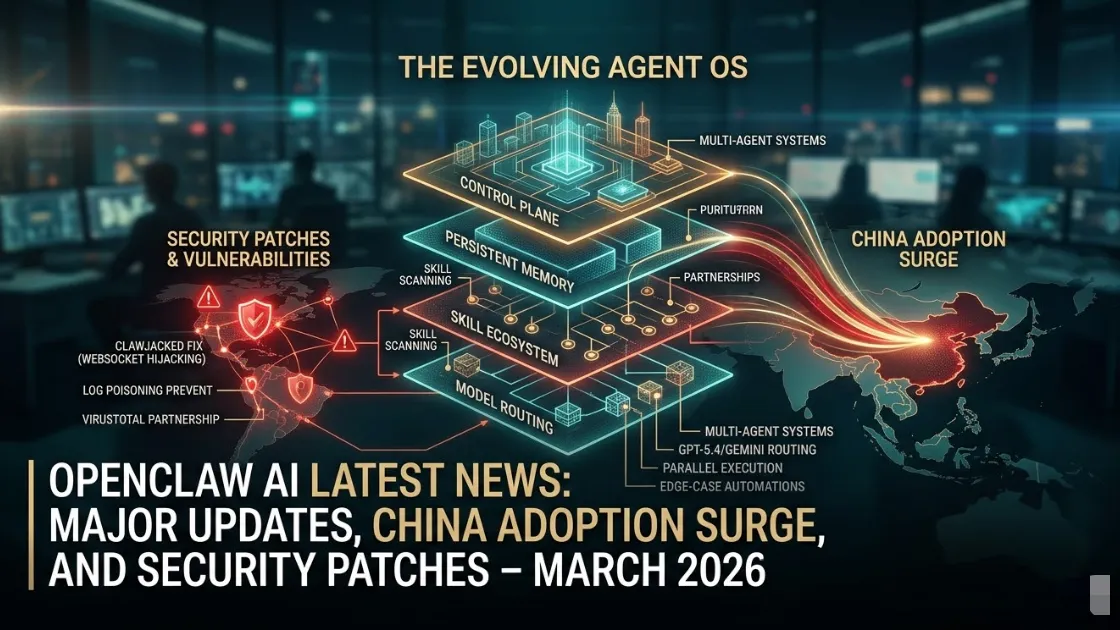
Analysis shows the agent's four-layer design—gateway control plane, persistent memory, skill ecosystem, and model routing—allows it to maintain state across sessions, execute terminal commands, and build custom capabilities autonomously.
Today's Major Platform Updates and Technical Advancements
Recent releases introduce multi-agent configurations activated by default, allowing coordinated workflows among specialized sub-agents. New integrations expand compatibility, while over 100 security and stability fixes harden the system against common pitfalls.
Key enhancements include:
- Model-agnostic routing supporting GPT-5.4, Gemini 3, and advanced Claude variants for optimal task performance.
- Persistent sessions and pluggable memory systems to prevent context loss in long-running operations.
- Secure secret storage and enterprise-grade hardening to mitigate risks from local execution privileges.
- Parallel task execution, delivering up to 10x speed improvements on complex automations.
Community feedback suggests these updates position OpenClaw as a foundational layer for an emerging AI operating system, where agents handle real-world productivity tasks with minimal human intervention.
China’s OpenClaw Craze: Adoption vs. Regulation
Adoption in China has reached fever pitch, with users and companies building custom agents at scale. Local governments in tech hubs like Shenzhen announce ecosystem support, including measures for "one-person companies" centered on OpenClaw.
Tech giants such as Tencent host setup sessions and launch compatible AI products, contributing to stock surges in related firms. However, central authorities restrict state-run enterprises and government agencies from deploying OpenClaw on official systems, citing data security concerns.
This dichotomy highlights the tension between open-source innovation and national security priorities, with private sector experimentation continuing unabated.
Security Landscape: Progress Amid Persistent Risks
Security vulnerabilities inherent to high-privilege local agents remain a critical discussion point. Recent patches fixed high-severity issues, including the ClawJacked flaw allowing malicious websites to hijack agents via WebSocket manipulation.
Additional mitigations address log poisoning, credential exposure, and the spread of malicious skills (71 reported instances of malware/crypto scams via ClawHub).
Partnerships like VirusTotal integration enable skill security scanning, while users are advised to:
- Run agents on dedicated, isolated devices.
- Enforce strict SOUL.md personality boundaries.
- Regularly audit granted permissions and apply updates promptly.
Benchmarks indicate these improvements significantly reduce exploit surfaces, though experts emphasize governance for agentic identities outside traditional IAM controls.
Practical Use Cases and Common Pitfalls
Advanced users leverage OpenClaw for inbox management, calendar orchestration, code refactoring, and even robotic integrations (e.g., spatial memory with Unitree G1 hardware). Proactive features like cron jobs and heartbeat tasks enable background automation.
Common pitfalls include:
- Overly permissive SOUL.md configurations leading to unintended actions.
- API rate limits or provider changes (recent reports of Anthropic access restrictions).
- Resource demands for local LLM inference versus cloud routing.
Edge cases demonstrate value in niche automations, such as persistent memory for personal journaling or multi-channel proactive reminders.
Conclusion
OpenClaw's trajectory in March 2026 underscores the shift toward truly agentic AI—systems that execute, remember, and adapt autonomously. With continuous updates addressing performance, security, and ecosystem needs, alongside global adoption patterns revealing both opportunities and risks, the project shapes the future of personal and team productivity tools.
For developers and power users ready to experiment, exploring the official repository and community resources provides the fastest path to implementation. Stay updated on releases to leverage the latest capabilities while maintaining robust security practices.
Ready to deploy your own OpenClaw agent? Start with a dedicated setup to maximize safety and performance.