

What is FastClaw?
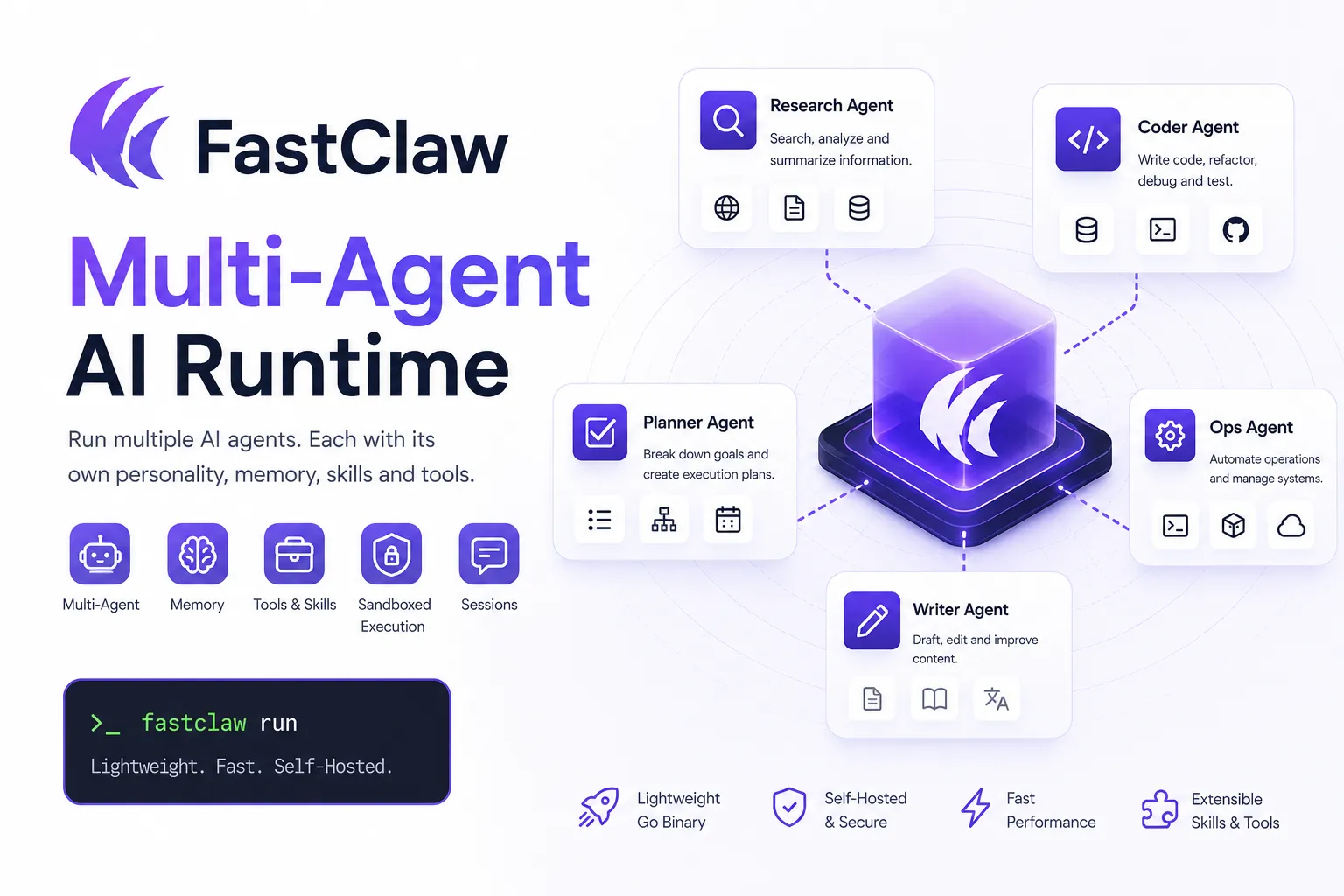
FastClaw is an open-source multi-agent framework designed to create, manage, and run AI agents. The project describes itself as an “Agent Factory”: instead of being a single chatbot, it provides a runtime where multiple agents can exist, each with its own configuration, personality, memory, skills, and tool access.
Its main appeal is operational simplicity. FastClaw is distributed as a lightweight Go binary, so teams can run agent workflows without assembling a large Python stack, container-heavy orchestration layer, or custom agent server from scratch. It is aimed at developers who want a self-hosted agent runtime that can talk to LLMs, execute tools, isolate work, and preserve sessions.
Core Features
FastClaw centers on agent creation and execution. Each agent can be defined with its own personality through files such as SOUL.md, giving teams a structured way to describe role, tone, goals, constraints, and behavior. This makes it useful for building specialized agents such as coding assistants, research agents, operations bots, support agents, or internal workflow assistants.
The runtime handles several pieces that are normally scattered across custom agent projects: LLM communication, tool execution, sandbox isolation, session management, memory, and skill loading. This allows developers to focus more on agent design and less on repeatedly rebuilding the infrastructure around prompt loops and tool calls.
FastClaw also fits into a broader ecosystem from the same organization, including related repositories for skills, plugins, messaging integrations, and tool adapters. That makes it more than a standalone demo: it is positioned as a base layer for building agent systems that can later connect to chat platforms, APIs, and custom tools.
Use Cases
FastClaw is a strong fit for developers experimenting with multi-agent workflows. For example, a team could define separate agents for planning, coding, reviewing, documentation, and deployment support, then run them in a controlled local or server environment.
It is also useful for self-hosted automation. Because FastClaw is designed around agents with tools and memory, it can support internal assistants that perform repeatable operational tasks, summarize information, call APIs, run scripts, or coordinate structured workflows.
Another natural use case is prototyping agent products. Instead of building the runtime layer first, developers can use FastClaw to validate whether a specific agent role, skill package, or tool workflow is useful before investing in a custom production architecture.
Developer Workflow
The basic workflow is to install the binary, configure an agent, attach skills or tools, and run tasks through the FastClaw runtime. The installation method shown by the project uses a shell install script that places the binary into the user environment, making it closer to a CLI-native developer tool than a hosted SaaS product.
Agents are configured as first-class units. This is important because many agent projects begin as a single prompt loop and become messy once they need different roles, different memory, different permissions, and different tools. FastClaw’s structure encourages users to treat agents as separate, reusable workers.
Why It Matters
The agent tooling market is crowded, but FastClaw’s differentiation is its lightweight runtime approach. Many AI agent frameworks are Python-heavy, notebook-oriented, or designed primarily as libraries. FastClaw instead emphasizes a single-binary runtime model, which can be easier to install, deploy, and reason about.
For builders, the practical value is speed: create agents quickly, run them locally or on a server, and add skills or integrations without turning every agent experiment into a full platform engineering project.
Comparison to Alternatives
Compared with general AI coding assistants, FastClaw is broader and more infrastructure-oriented. It is not only an editor assistant; it is a runtime for defining and executing multiple agents.
Compared with large agent frameworks, FastClaw appears more focused on operational simplicity and self-hosted execution. It may not have the same maturity, ecosystem size, or enterprise polish as older frameworks, but it offers a clear path for developers who want a compact agent runtime with sandboxing, tools, memory, and session handling.
Compared with hosted agent platforms, FastClaw gives developers more control over deployment and architecture. The tradeoff is that users must manage configuration, model access, infrastructure, and security practices themselves.
Best For
FastClaw is best for developers, indie hackers, AI tool builders, and technical teams that want to run their own agents without depending entirely on a hosted agent service. It is especially relevant for people building agent-based products, internal automation systems, multi-agent experiments, or self-hosted AI assistants.
It may be less suitable for non-technical users who want a polished no-code agent builder. The project is developer-facing and assumes comfort with command-line tools, API keys, configuration files, and agent runtime concepts.
Security and Operations Notes
Because FastClaw can execute tools and run agent workflows, users should treat it as infrastructure with real permissions. Tool access, sandbox boundaries, credentials, file-system access, and network access should be configured carefully, especially when agents are allowed to call scripts, APIs, or external services.
For production use, teams should review the repository, deployment model, license, update cadence, and security assumptions before exposing agents to sensitive systems or customer data.