

Overview
MimiClaw is an open-source project that brings powerful AI agent capabilities to extremely low-cost hardware. It reimplements core OpenClaw functionality to run natively on ESP32-S3 microcontrollers in pure C, without requiring a full operating system, Node.js, Raspberry Pi, or cloud VPS.
The device functions as a personal AI assistant: plug it into USB power, connect to WiFi, and interact via Telegram. It handles tasks, maintains local persistent memory across power cycles, and provides a private, always-available edge AI experience.
Key Features
- Ultra-low cost hardware: Runs on $5–10 ESP32-S3 boards (e.g., LilyGo T-Display S3)
- Bare-metal execution: Pure C implementation, no Linux or heavy runtime
- Telegram integration: Chat naturally with your AI assistant
- Persistent local memory: Context and knowledge retained even after power-off
- Privacy-first: All processing happens locally on the device with optional LLM calls
- Easy setup: Flash via ESP-IDF, simple WiFi and Telegram configuration
- Hardware agent foundation: Designed as a building block for physical AI agents and IoT orchestration
Hardware Requirements
- ESP32-S3 development board (recommended: LilyGo T-Display S3 or similar)
- USB power source
- WiFi network access
Getting Started
- Clone the repository:
git clone https://github.com/memovai/mimiclaw.git - Set target:
idf.py set-target esp32s3 - Build and flash the firmware
- Configure WiFi and Telegram bot token
- Power on and start chatting!
Detailed flashing guides, including pre-built binaries and OTA updates, are available in the repository releases.
Use Cases
- Personal pocket AI companion for reminders, quick queries, and daily assistance
- Privacy-sensitive edge computing where cloud dependency is undesirable
- Experimentation with hardware AI agents and embedded intelligence
- Low-power, portable automation for makers and hobbyists
- Foundation for custom physical AI devices and wearables integration experiments
Architecture
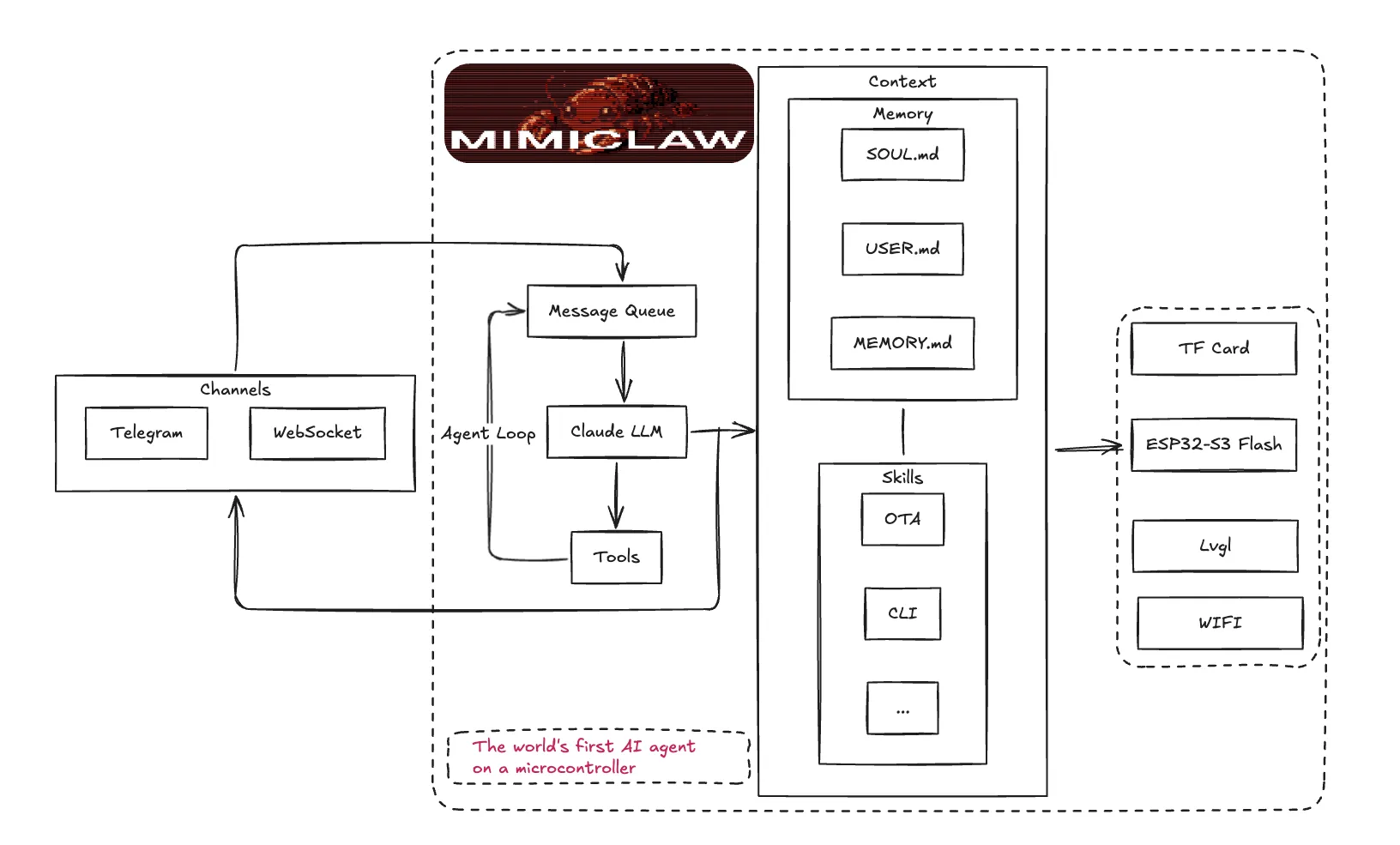
MimiClaw implements a lightweight agent loop directly on the microcontroller. It bridges Telegram messages to LLM inference (with support for remote models like Claude) while keeping memory and core logic local. The design emphasizes minimal resource usage, reliability, and extensibility for hardware control.
Community and Support
- GitHub: https://github.com/memovai/mimiclaw (MIT License)
- Active discussions in AI agent and embedded communities
- Contributions welcome for performance, features, and documentation
MimiClaw democratizes advanced AI agents by making them accessible on commodity hardware, paving the way for truly ubiquitous and private personal AI.