

Decision information
Manual verification pending- Ecosystem category
- Infrastructure
- Content type
- Resource
- Pricing
- Unknown
- Open source
- Unknown
- License
- Not recorded
- Maintenance
- Unknown
- Install methods
- Not recorded
- Platforms
- Not recorded
What Is OpenFang?
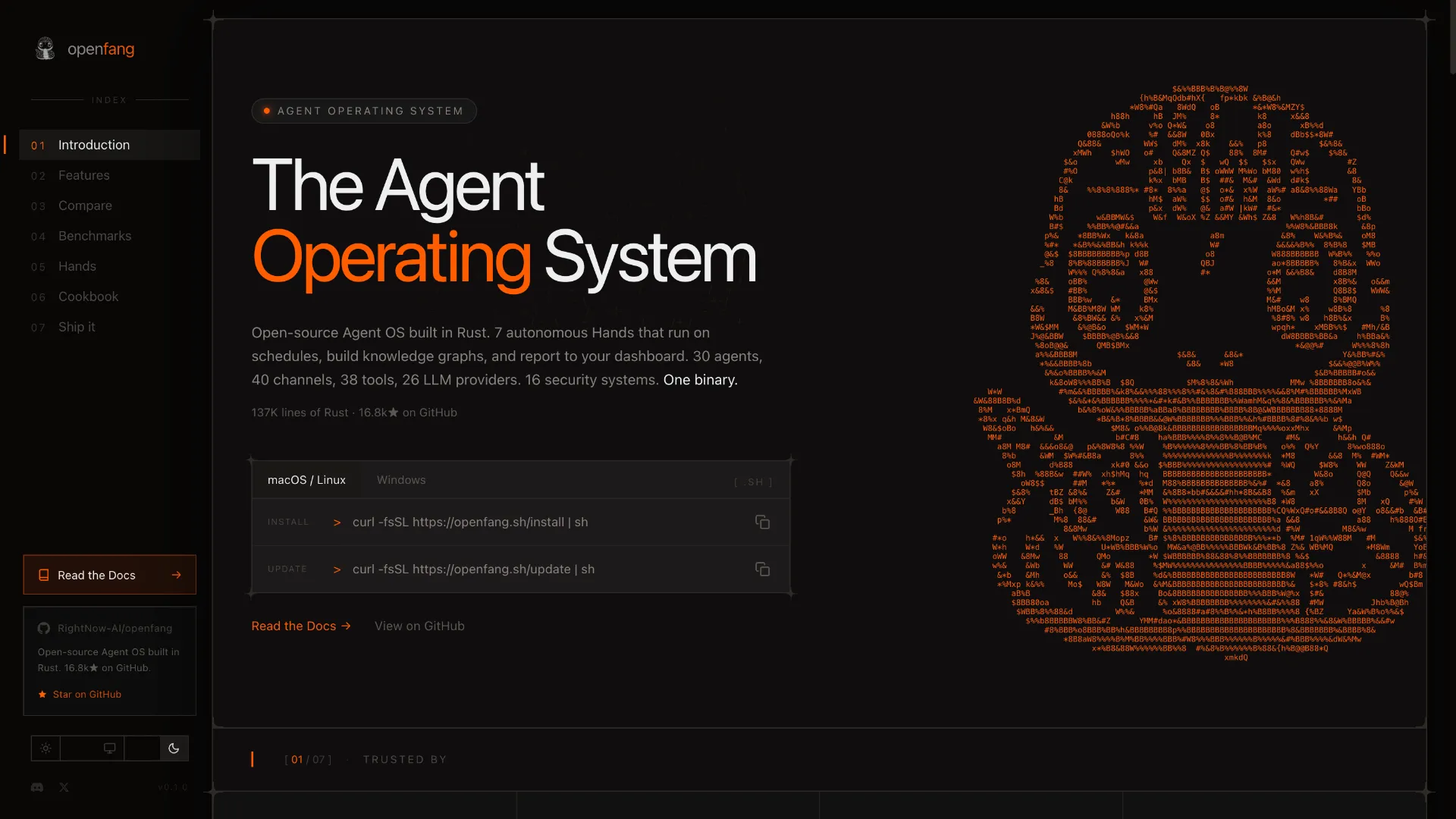
OpenFang is an open-source Agent Operating System created by RightNow AI. Rather than positioning itself as another Python LLM wrapper or chat-oriented agent framework, OpenFang provides a persistent runtime for creating, running, scheduling, securing, and connecting autonomous AI agents. The core system is written in Rust and distributed as a relatively compact standalone binary.
The distinction is important: OpenFang is designed around agents that can remain active beyond an individual chat session. They can execute scheduled jobs, maintain memory, use tools, communicate through external channels, coordinate with other agents, and deliver results without requiring a user to manually initiate every task.
Features
Autonomous Hands
One of OpenFang's defining concepts is Hands. A Hand is a packaged autonomous capability containing its own manifest, operational instructions, domain knowledge, settings, required tools, guardrails, and dashboard metrics.
Hands can run independently and on schedules rather than acting only when a user sends a message. OpenFang includes bundled Hands covering tasks such as research, lead generation, monitoring, forecasting, browser automation, media processing, and social publishing.
This makes Hands closer to packaged autonomous workers than conventional reusable prompts.
Agent Runtime
OpenFang includes an agent runtime responsible for lifecycle management, execution, communication, memory, tools, and scheduling. It also includes pre-built agent templates covering roles such as research, development, orchestration, review, and support.
Agents can be created and operated from the CLI, dashboard, APIs, workflows, or messaging-channel integrations.
Persistent Memory
OpenFang provides persistent agent memory backed by SQLite, with support for vector embeddings and conversation or session persistence.
Its memory architecture allows agents to retain relevant context across separate interactions instead of treating every request as an isolated prompt. This is especially useful for long-running research agents, assistants, monitoring systems, and recurring automation.
Built-In Tools and MCP
The runtime includes native tools for operations such as web access, browser automation, filesystem interaction, media processing, image generation, text-to-speech, Docker workflows, and knowledge-graph operations.
OpenFang also implements Model Context Protocol (MCP) support. This allows agents to consume tools exposed by external MCP servers and participate in the wider MCP ecosystem.
A2A and Agent Interoperability
In addition to MCP, OpenFang supports Agent-to-Agent (A2A) communication for interactions between agents and compatible agent platforms.
Supporting both tool-level interoperability through MCP and agent-level interoperability through A2A makes OpenFang suitable for heterogeneous agent systems where different runtimes and services need to cooperate.
Messaging Channels
OpenFang provides a large collection of messaging and communication adapters, including integrations for platforms such as:
- Telegram
- Discord
- Slack
- Microsoft Teams
- Matrix
- IRC
Agents can use these channels to receive requests or automatically deliver scheduled results. This makes it possible to operate the same underlying agent through several communication surfaces.
LLM Provider Support
OpenFang supports multiple hosted and local LLM providers through native and OpenAI-compatible interfaces.
Compatible providers and runtimes include services such as OpenAI, Anthropic, Google Gemini, DeepSeek, Groq, OpenRouter, Together AI, Mistral, Fireworks, Cohere, xAI, Cerebras, Ollama, vLLM, LM Studio, Qwen, MiniMax, Moonshot, AWS Bedrock, and others.
This provider-neutral approach helps developers switch models, use local inference, introduce fallbacks, or optimize agent workloads for different cost and performance requirements.
Workflows and Scheduling
OpenFang is designed for workloads that continue running after the initial request. Its workflow system supports multi-step agent pipelines and scheduled execution.
Typical automation patterns include:
- Conditional execution.
- Repeated or loop-based tasks.
- Fan-out workflows.
- Multi-agent pipelines.
- Scheduled jobs.
- Multi-destination result delivery.
A scheduled job can be used to perform research, monitoring, reporting, lead generation, or other recurring tasks without requiring manual prompts each time.
Typical examples include:
- Running competitive research every morning.
- Monitoring a company, topic, or website for changes.
- Generating and delivering recurring reports.
- Performing scheduled lead-generation workflows.
- Coordinating several specialist agents in a pipeline.
- Sending results automatically to Slack, Telegram, Discord, or other channels.
Security Architecture
Security is treated as a runtime-level concern rather than relying entirely on agent prompts. OpenFang includes multiple security mechanisms intended to reduce risks associated with autonomous tools and long-running agents.
Security capabilities include areas such as:
- WASM sandboxing and execution controls.
- Workspace-confined filesystem operations.
- Subprocess isolation and timeouts.
- Signed manifests.
- Audit trails.
- Taint tracking.
- SSRF protections.
- Prompt-injection scanning.
- Path-traversal protections.
- Secret handling.
- Authentication controls.
- Rate limiting.
These protections become increasingly important when an autonomous agent has access to browsers, shell commands, APIs, local files, credentials, and external communication channels.
Skills
OpenFang supports reusable SKILL.md-style skills for extending agent knowledge and capabilities.
Skills can package instructions, configuration, tools, and reusable logic for specific tasks. They can also declare required configuration variables and secrets, making it easier to distribute reusable capabilities without hardcoding environment-specific values.
This model can be useful for teams building internal skill libraries or adapting capabilities from the broader agent-skill ecosystem.
OpenClaw Migration
OpenFang includes migration tooling for users moving from OpenClaw-compatible environments.
Migration workflows can help transfer compatible agent definitions, conversation history, skills, and configuration. A dry-run workflow can be used before applying changes.
Example:
bash openfang migrate --from openclaw --dry-run openfang migrate --from openclaw
This makes OpenFang especially relevant to developers exploring Rust-based infrastructure for existing Claw-style autonomous-agent deployments.
API and Developer Integration
OpenFang exposes APIs for programmatic access to the runtime and its agents. Integration surfaces include HTTP, WebSocket, and Server-Sent Events interfaces.
The APIs cover functionality such as:
- Agents.
- Conversations.
- Memory.
- Workflows.
- Schedules.
- Channels.
- Models.
- Skills.
- Hands.
- Agent-to-agent communication.
OpenFang also provides an OpenAI-compatible chat interface, which can make integration easier for software already designed around OpenAI-style chat completion APIs.
Desktop and Dashboard Experience
OpenFang includes a web dashboard for managing agents, conversations, providers, schedules, Hands, skills, and other runtime components.
The project also includes a desktop-oriented experience based on Tauri. This provides a more accessible management layer for users who do not want to operate the entire system through terminal commands and configuration files.
Desktop-oriented functionality can include capabilities such as system-tray operation, notifications, startup behavior, and shortcuts.
Installation
On macOS and Linux, the standard installation flow is:
bash curl -fsSL https://openfang.sh/install | sh openfang init openfang start
openfang init is used for initial setup and provider configuration, while openfang start launches the runtime and management interface.
Windows and multiple CPU architectures are also supported through platform-specific release packages.
Use Cases
OpenFang is most relevant when an application needs more than a request-response chatbot.
Practical use cases include:
- Autonomous research: Continuously research topics and generate structured reports.
- Monitoring and intelligence: Watch companies, competitors, products, markets, or topics for meaningful changes.
- Lead generation: Research, enrich, and score potential customers on a recurring schedule.
- Content automation: Transform source material into reusable or distributable content workflows.
- Multi-agent systems: Assign different responsibilities to specialized agents and coordinate their execution.
- Messaging assistants: Run persistent agents through Telegram, Discord, Slack, WhatsApp, Teams, and other channels.
- Developer automation: Combine agents with shell, filesystem, browser, API, Docker, MCP, and development tools.
- Self-hosted AI infrastructure: Operate a centralized agent runtime while choosing between hosted and local models.
OpenFang vs. Traditional Agent Frameworks
OpenFang occupies a somewhat different layer from agent libraries such as LangGraph, CrewAI, or AutoGen.
Traditional agent frameworks are generally embedded inside an application and provide primitives for agent orchestration. OpenFang attempts to provide more of the surrounding operational environment itself, including:
- Agent lifecycle management.
- Scheduling.
- Persistent memory.
- Tool execution.
- Messaging channels.
- Security controls.
- APIs.
- Dashboard management.
- Long-running autonomous processes.
This makes OpenFang potentially attractive for persistent autonomous services, although it may provide more infrastructure than necessary for a small prototype or simple conversational application.
Why OpenFang Is Interesting
OpenFang's strongest differentiation is its attempt to treat AI agents as persistent software processes rather than temporary LLM conversations.
Instead of requiring developers to separately assemble an agent framework, scheduler, database, messaging integrations, tool sandbox, API layer, and operational dashboard, OpenFang brings these components into a more unified runtime.
Its Rust implementation is also notable in an ecosystem where many agent frameworks are primarily Python or TypeScript projects. Rust can provide advantages around deployment footprint, predictable performance, concurrency, and runtime safety for always-on agent infrastructure.
Who Should Consider OpenFang?
OpenFang is particularly relevant for developers and teams building persistent autonomous agents rather than simple AI chat interfaces.
It is especially worth evaluating when requirements include:
- Long-running agents.
- Recurring autonomous jobs.
- Multi-agent orchestration.
- Multiple messaging channels.
- MCP integration.
- A2A interoperability.
- Hosted and local model support.
- Centralized agent management.
- Runtime-level security controls.
- Self-hosted deployment.
For notebook experiments, simple prototypes, or applications deeply tied to Python machine-learning libraries, a conventional agent framework may remain easier to adopt. OpenFang becomes more compelling when the challenge shifts from building one agent to operating autonomous agents as persistent software services.